It seemed only natural that we have a science birthday party this year for Lucy's 7th birthday.
The periodic table was the inspiration for the invitations and decor.
I pulled out all my beakers and flasks for this party. I think Mike was surprised by my inventory.
The girls and I had fun making the cookies for the party. I baked but they helped ice them. I used a edible pen to mark on the dried icing.
We also made these great petri dishes filled with Jello, but I forgot to get them out of the refrigerator until after all the guests had gone.
But the real fun began when the guests arrived.
We made large bubbles out on the driveway.
We made lava lamps in the backyard. I didn't get any pictures, ugh.
We made dry ice bubbles inside.
We also played with dry ice outside.
We did the mentos and diet coke experiment.
I also attempted the elephant's toothpaste demo but it was an epic failure. Oh well.
Lucy opened presents and got lots of Legos, which she wanted desperately.
Thank you to all the little scientists that came to Lucy's party.
Lucy, you are such a kind hearted girl. Happy birthday sweet princess. I am so glad you are my baby. I love you more every day.
Showing posts with label Science. Show all posts
Tuesday, July 7, 2015
Lucy's 7th Birthday Pary
Labels:
Chemistry,
Erlenmeyer Flask,
flask lamp,
My Girls,
periodic table,
periodic table table,
Science
Tuesday, June 2, 2015
How we made our Periodic Table-Table
Many people have asked, so here goes:
I ordered a black periodic table poster from Pottery Barn, way back last October when they had their mad scientist collection. It is a black canvas poster on a black table. I cut the wood off the top and the bottom, so it was just canvas. Then I ordered glass from Tulsa Glass cut to fit my table. I simply placed the canvas on the table and put the glass over it. Simple, yet pretty.
| Our Periodic Table |
For the lamp, it was a bit more complex. Mike and I went to Best hardware on Brookside (if you're local) and this wonderful man named Leroy helped with all the lamp components. The bulb going down into the Erlenmeyer flask is by Bulbrite. Mike built a socket that goes up and a socket that goes down. (He is so handy!) He even put a switch on the wire that allows me to have a high and low setting.
| Erlenmeyer Flask Lamp |
Thanks Mike for enabling me to let my geek shine through!
Labels:
Erlenmeyer Flask,
flask lamp,
geek,
nerd alert,
periodic table,
periodic table puns,
periodic table table,
Science
Monday, May 25, 2015
Making the Lamp
Everyday is mother's day around my house. I ask Mike to build me something and he builds it.
He made me this lamp!
In the neck of the lamp are two light sockets. One that goes up and one that goes down. There is a short edison bulb going up and a long edison bulb going down. Here is a glimpse of the innards.
I found the flask here.
He made me this lamp!
In the neck of the lamp are two light sockets. One that goes up and one that goes down. There is a short edison bulb going up and a long edison bulb going down. Here is a glimpse of the innards.
I found the flask here.
Labels:
Chemistry,
Erlenmeyer Flask,
periodic table,
Science
Friday, May 15, 2015
Our Table of Elements Where We Eat Periodically
I have been wanting to turn my kitchen table into a periodic table for about a year. I finally did it!
Addendum: I wanted to turn the large Erlenmeyer flask in the back into a lamp. So I asked my handy husband to build me a lamp. We went to a local hardware store called Best Hardware. I nice man named Leroy who has owned the store for 40 years helped us get the pieces we needed. Then we came home and Mike wired it all together. He even put in a switch that dims it.
Yea, that is an extra long Edison bulb down in the flask. I am going to sit there tonight and look my new lamp on my periodic table.
Tuesday, March 10, 2015
Separating water into H2 and O2
Here we connected two pieces of copper wire to a 9-volt battery. We filled two test tubes and a beaker with distilled water. We added baking soda to the water because we needed the ions to transfer the H+ and the OH-. Hydrogen gas formed readily but the oxygen gas was inhibited by the copper oxidizing at the anode. We are going to try this experiment again with different electrodes.
Thursday, March 5, 2015
Snow Day
What we do when school is out and mom is home.
We bake.
This is the best icing I have ever had. I has five ingredients and none of them are shortening. Here is the link to the recipe. If you don't care for super sweet icing, then this icing is for you.
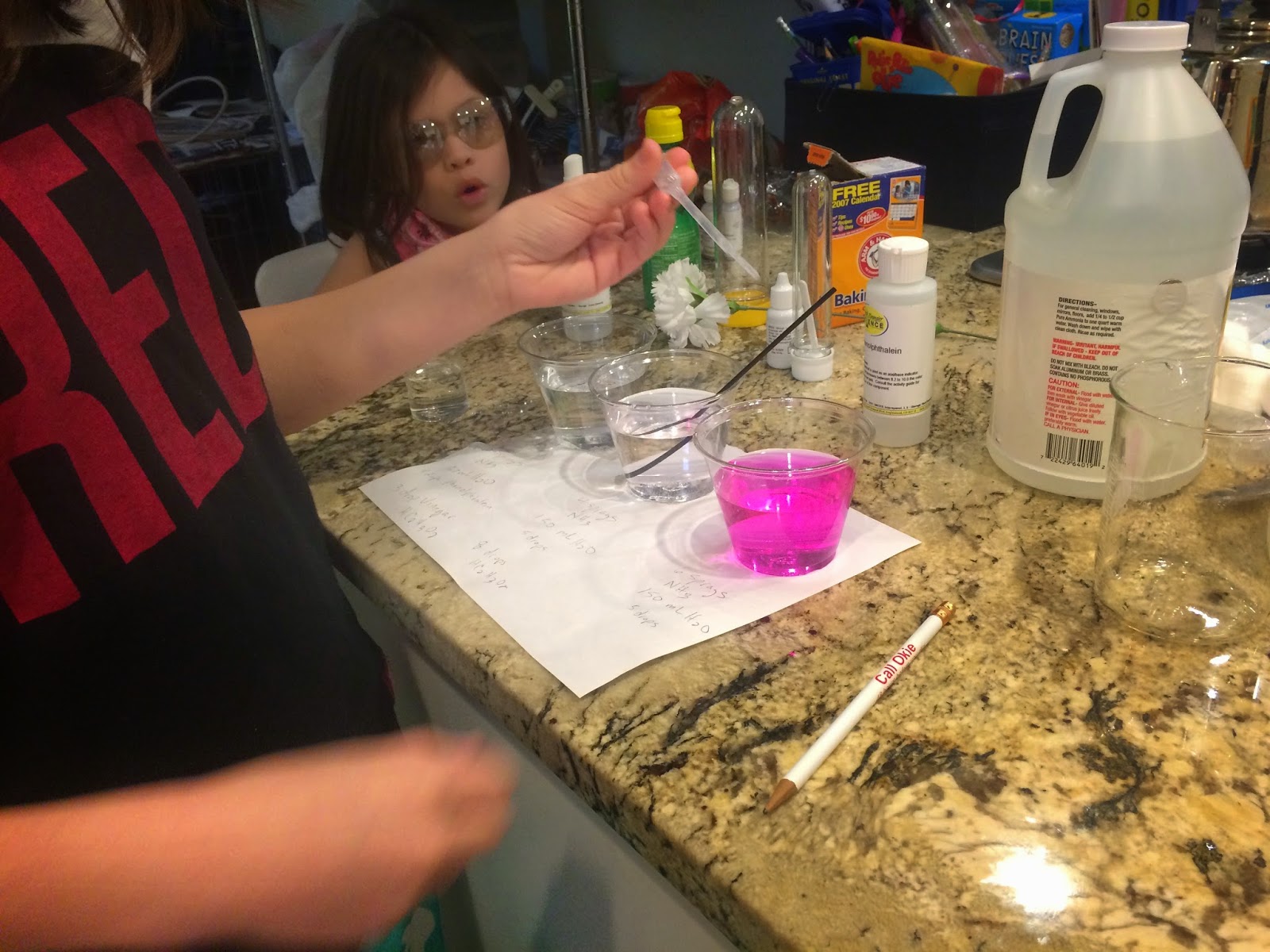
The morning was spent baking, then we moved on to science. We covered acid/base reactions by using vinegar (HC6H12O2), Ammonia (NH3) and Phenolthalein.
Awesome Day!
We bake.
This is the best icing I have ever had. I has five ingredients and none of them are shortening. Here is the link to the recipe. If you don't care for super sweet icing, then this icing is for you.
The morning was spent baking, then we moved on to science. We covered acid/base reactions by using vinegar (HC6H12O2), Ammonia (NH3) and Phenolthalein.
Friday, October 10, 2014
Carbon Dioxide
When Lucy loses track of me or wants my attention in a busy store, she
yells "Carbon Dioxide" instead of Mommy. This sets her apart from all
the other kids yelling "mommy". It is a very unique but effective
call. It is said that mama birds teach their young a distinct call so
that they know their babies cry. This is ours.
Wednesday, January 8, 2014
Tree, Behold your Apple
Since she could talk and ask questions, I have been answering Emma's questions with the most detailed answer possible. Every question for me has been a "teachable moment".
I have now created a person who answers questions with such detail that I am often struck speechless.
In the car, where all great conversations happen and I need a go-pro camera installed with a steering wheel trigger mount to cue recording, Lucy asked, "Why do camels have fur if they live in the desert?"
While I was pondering a good answer when Emma jumped in with
It gets very cold in the desert at night, so the fur helps keep them warm when the temperature drops. During the day it also helps keep them protected from the intense sun so that they don't get sunburned. It also probably helps them to keep their body temperature regulated. You know Lucy, not all deserts are hot. In fact the definition of a desert is just a place that gets very little rainfall. Some deserts are called high deserts and they never get hot. There is one in Argentina that never gets warm, although they don't have any camels there. I only bring it up so that you don't go through life thinking that deserts are warm. They are just dry.
I just kept my mouth shut and drove. Lucy, as always, remembers everything Emma says and now knows all about Patagonia.
I asked Emma later where she learned so much about deserts. She said she read about them in a book titled Encyclopedia Britannica Letter D. I am pretty sure that was a page turner.
A couple of mornings ago when we were near zero degrees, we left the faucets running all night. She was brushing her beautiful hair and had static electricity on her brush. When I walked into her room, presumably to wake her up, she was holding her brush near the stream of water coming from the faucet and causing it to not fall straight down anymore. (The water will become attracted or repelled from the hairbrush.) She noticed me watching her and said, "Look Mom, the static electricity from my brush is causing the water to change direction."
Seriously.
I have now created a person who answers questions with such detail that I am often struck speechless.
In the car, where all great conversations happen and I need a go-pro camera installed with a steering wheel trigger mount to cue recording, Lucy asked, "Why do camels have fur if they live in the desert?"
While I was pondering a good answer when Emma jumped in with
It gets very cold in the desert at night, so the fur helps keep them warm when the temperature drops. During the day it also helps keep them protected from the intense sun so that they don't get sunburned. It also probably helps them to keep their body temperature regulated. You know Lucy, not all deserts are hot. In fact the definition of a desert is just a place that gets very little rainfall. Some deserts are called high deserts and they never get hot. There is one in Argentina that never gets warm, although they don't have any camels there. I only bring it up so that you don't go through life thinking that deserts are warm. They are just dry.
I just kept my mouth shut and drove. Lucy, as always, remembers everything Emma says and now knows all about Patagonia.
I asked Emma later where she learned so much about deserts. She said she read about them in a book titled Encyclopedia Britannica Letter D. I am pretty sure that was a page turner.
A couple of mornings ago when we were near zero degrees, we left the faucets running all night. She was brushing her beautiful hair and had static electricity on her brush. When I walked into her room, presumably to wake her up, she was holding her brush near the stream of water coming from the faucet and causing it to not fall straight down anymore. (The water will become attracted or repelled from the hairbrush.) She noticed me watching her and said, "Look Mom, the static electricity from my brush is causing the water to change direction."
Seriously.
Wednesday, November 27, 2013
Dry Ice Bubbles
Disclaimer: NEVER SEAL DRY ICE INTO A CLOSED CONTAINER. IT WILL EXPLODE AND HURT YOU AND THOSE AROUND YOU. Don't touch dry ice...duh...
This is what happens when you have an inquisitive daughter who LOVES SCIENCE. She reads science books and comes to you and says "Mom, can we do this experiment at my next birthday party?"
You can order a kit from Steve Spangler here. But we decided we could make one ourselves. Be sure to watch the YouTube video from their site...it's "awesome sauce" as Emma would say.
So our sweet exhausted Mike, who has been working all day and going to work from midnight to 4 in the morning, somehow found the time to drill a hole in glass so that we could make our own apparatus.
The jar is one of those drink dispensers that I never used with a hole drilled in it with a glass drill bit. We used the lid to control the amount of CO2 forced out the plastic tubing. Be sure to keep the water level below the tubing so only water vapor and CO2 are forced out. Use leather gloves to pick up the dry ice and put in warm water. THE DRY ICE WILL BURN YOU IF YOU TOUCH IT. DO NOT LET CHILDREN PLAY WITH DRY ICE. I handled the dry ice (with heavy duty gloves) and placed it in the container myself. Other than the dry ice, there is nothing else dangerous about this experiment. I felt very safe letting the kids play with the bubbles. I did make them wear goggles because of the dry ice and the soap.
We used warm water and dry ice to create the fog of CO2. Then forced it into the plastic tubing which we dipped into a cup of Dawn dish soap.
This was our practice session for her upcoming birthday party. We weren't sure what kind of soap solution would work best and if we had the right kind of gloves to actually keep the bubbles from popping. This "dry" run was worth the money spent. We needed the practice to figure out the right mixture of soap. In the photo below we tried bubble solution, but it did not work as well as the Dawn dish soap.
At first the bubbles popped immediately. Then we added more soap and got the concentration of Dawn higher and the bubbles lasted a lot longer and really bounced like in the video. The big girls could actually toss them back and forth. We also learned that the first towel we had down was too stiff and bumpy and was popping all the bubbles. Once we got a softer towel down the bubbles stopped bursting.
The science behind it. Dry ice is solid carbon dioxide. When it warms up to room temperature it sublimates, (it turns into a gas without going through the liquid stage). We can help this process along by putting it into warm water and it really goes to town. The carbon dioxide gas comes off so fast and it takes some water vapor along with it. This fog pours out the top of the container until we put a lid on it (NEVER SEAL DRY ICE INTO A CONTAINER IT WILL BUILD UP PRESSURE AND EXPLODE AND HURT YOU) and force it out the plastic tube. The plastic tube is put into the soap solution and the bubbles are filled with Carbon Dioxide which is heavier than air (which is mostly nitrogen) and water vapor. The bubbles are heavy and with the cotton gloves and a thick surfactant like the dawn dish soap you can keep the bubbles from bursting and play with them. They bounce and roll across the towel. And then they pop, they release their CO2 and water vapor fog.
We invited fellow science nerd Jennifer K and her daughter Lily over to for our trial run. Thanks for playing with us while we worked out the kinks. I think we are ready!
This is what happens when you have an inquisitive daughter who LOVES SCIENCE. She reads science books and comes to you and says "Mom, can we do this experiment at my next birthday party?"
You can order a kit from Steve Spangler here. But we decided we could make one ourselves. Be sure to watch the YouTube video from their site...it's "awesome sauce" as Emma would say.
So our sweet exhausted Mike, who has been working all day and going to work from midnight to 4 in the morning, somehow found the time to drill a hole in glass so that we could make our own apparatus.
The jar is one of those drink dispensers that I never used with a hole drilled in it with a glass drill bit. We used the lid to control the amount of CO2 forced out the plastic tubing. Be sure to keep the water level below the tubing so only water vapor and CO2 are forced out. Use leather gloves to pick up the dry ice and put in warm water. THE DRY ICE WILL BURN YOU IF YOU TOUCH IT. DO NOT LET CHILDREN PLAY WITH DRY ICE. I handled the dry ice (with heavy duty gloves) and placed it in the container myself. Other than the dry ice, there is nothing else dangerous about this experiment. I felt very safe letting the kids play with the bubbles. I did make them wear goggles because of the dry ice and the soap.
We used warm water and dry ice to create the fog of CO2. Then forced it into the plastic tubing which we dipped into a cup of Dawn dish soap.
This was our practice session for her upcoming birthday party. We weren't sure what kind of soap solution would work best and if we had the right kind of gloves to actually keep the bubbles from popping. This "dry" run was worth the money spent. We needed the practice to figure out the right mixture of soap. In the photo below we tried bubble solution, but it did not work as well as the Dawn dish soap.
At first the bubbles popped immediately. Then we added more soap and got the concentration of Dawn higher and the bubbles lasted a lot longer and really bounced like in the video. The big girls could actually toss them back and forth. We also learned that the first towel we had down was too stiff and bumpy and was popping all the bubbles. Once we got a softer towel down the bubbles stopped bursting.
The science behind it. Dry ice is solid carbon dioxide. When it warms up to room temperature it sublimates, (it turns into a gas without going through the liquid stage). We can help this process along by putting it into warm water and it really goes to town. The carbon dioxide gas comes off so fast and it takes some water vapor along with it. This fog pours out the top of the container until we put a lid on it (NEVER SEAL DRY ICE INTO A CONTAINER IT WILL BUILD UP PRESSURE AND EXPLODE AND HURT YOU) and force it out the plastic tube. The plastic tube is put into the soap solution and the bubbles are filled with Carbon Dioxide which is heavier than air (which is mostly nitrogen) and water vapor. The bubbles are heavy and with the cotton gloves and a thick surfactant like the dawn dish soap you can keep the bubbles from bursting and play with them. They bounce and roll across the towel. And then they pop, they release their CO2 and water vapor fog.
We invited fellow science nerd Jennifer K and her daughter Lily over to for our trial run. Thanks for playing with us while we worked out the kinks. I think we are ready!
Wednesday, October 23, 2013
Happy Mole Day!
Today is October 23rd. And Chemists know that today is Mole day. A day that the number 6.02 x 10 23 is celebrated as the greatest number ever known to man.
I blogged about my obsession about the number here.
So pop open a bottle of C6H6O and celebrate! Happy Mole Day everyone!
I blogged about my obsession about the number here.
So pop open a bottle of C6H6O and celebrate! Happy Mole Day everyone!
Tuesday, April 30, 2013
A Little Light Reading
Well today a dream came true. Emma Jane wants to read this book every night. She wants to study an element every night. She was so excited about Hydrogen tonight I thought she might combust. We delved into protons, neutrons and electrons, and we covered Avogadro's number pretty well. I had to resist the urge to run to the kitchen and get out a scale and weigh out one Mole of sodium chloride. (I just explained it instead.).
I'm kind of freaking out. She is so excited. I'm not sure I can sleep. Maybe a little C2H5OH will help.
Monday, March 18, 2013
A Wedding, Three Lucys and a Leprechaun
What have we been doing this week?
We had something going on every single night this week. We had student led conferences on Tuesday and that was wonderful. I am so lucky my girls love school and have such outstanding teachers. We also had swimming lessons twice this week. Lucy moved from level 1 to level 2 class this week. They decided she was too advanced to be in beginning swimming. I wish you could hear the 4 year old version of her advancing in her swim class. It goes something like this. "Last week I did number 1 but this week I will do number 2 in the pool!"
We also had gymnastics and then went to watch the sun set so we could catch a glimpse of the comet, PanSTARRS. Emma was so thrilled. She jumped up and down and forgot all about being cold. Lucy was sort of interested, but the need for warmth won out over the curiosity of seeing a tiny dot in the sky through binoculars.
We went sailing on Friday with our sweet babysitter/sister/friend/mentor/role model, Madeline. It was 80 degrees and beautiful on the lake. It got pretty windy but Mike reefed the main and we kept things pretty steady on the boat. I forgot my camera so I am relying on Madeline to send me some pictures from that day (hint, hint).
On Friday night we went to a wedding for one of Emma Jane's teachers. She got married in the school!
Her name is LeeAnne Power. And she has a daughter named Lucy Power. In the car on Friday, Lucy was saying that her mom had mommy power and her dad had daddy power and her sister had sissy power and that she had LUCY POWER. I explained that she was, in fact, going to meet a girl named Lucy Power. She was not very excited.
I did manage to get a photo of the 3 Lucy P's at the wedding that night. Pictured are Lucy Piper, Lucy Power and Lucy Plunkett. Tri Lucy. Lucy cubed.
I was pretty excited, but I think I was the only one. You see, both their first and last names can be spelled using elements. Sadly, Plunkett cannot. I know when I tell people this, the blank stare on their face should make me realize that they just don't really find it interesting. You would think that I would stop. But I don't. I went ahead and made some files in case they want t-shirts made...
Just smile and nod. I know I am weird.
On Saturday we went to the lake for the spring racing series. We were to be crewing for Daniel who has a Corsair 31 trimaran. The winds were too strong for little Lucy. At the beginning of the first race, while I was at the helm of a 31 foot boat sailing 17 knots, getting sprayed by water, and having the time of my life, Lucy burst into tears. She was scared and didn't like all the banging above board. So I went down and held her through race one. Then they delivered us back to the dock before races 2 and 3. We sat on our boat in a very calm marina with no loud noises or choppy seas. We had snacks and watched a movie. All was calm, all was well.
We waited for Mike and Daniel (the skipper of the 31 foot boat) to return and then we ate and visited with all the friends we haven't seen all winter. I love the first day back in the spring. It is so good to see everyone and catch up.
On Sunday we had lake friends over for dinner. It was St. Patrick's day and Emma Jane got crafty. She made a leprechaun trap. (I do not know where this idea came from.) She had a gold coin to attract him and then a trap door triggered so that as he pulled the coin the lid slams shut. We are still waiting to hear the lid slamming shut in the night.
And because it was Sue's birthday (the day after St. Patrick's day) and because Sue is Irish, and because Emma did not catch a leprechaun, she made a leprechaun for Sue.
What a crafty and creative girl she is.
Wednesday, March 6, 2013
What Is Mass?
When Emma was just 4 years old and had just started at Mayo Demonstration School for Science and Technology, she was having her after school snack and asked me, "Mom, what's mass?"
I freaked out. I was so ecstatic. My 4 year old daughter who had just started school was learning about mass and asking me to explain it to her???? I said as calmly as I could "Well Emma Jane, I am so glad you asked. Mass is the amount of matter in a substance irregardless of gravity. Your mass here is the same as your mass on the moon, but your weight would be different. For example, my weight here on earth is 135 but my weight on the moon would be 23 pounds. Weight is related to gravity but mass is independent of gravity."
Then I went to get a pan balance that I just happen to have in the craft room and set up a quick experiment in the kitchen in which we were going to determine the mass of the Oreos she was eating. I was explaining that we were going to compare the mass of the Oreos to something with a known mass. She hesitated for a moment, knowing that she was derailing the science train barreling down the track and said, "Mom, I think it's church. Sophie invited me to go on Saturday."
"Oh," I said.
Subscribe to:
Posts (Atom)